-
Home

-
The Services
-
The Numbers
-
Analytics
- Search Engine Optimization

Search Engine Optimization (3)
Information pertaining to search engine optimization.
 Search engine optimization (SEO) is mostly about following guidelines.
Here's one page from Google that is worthwhile checking out whether you are new to SEO or have some experience. It's called "Do you need an SEO?". It will answer some questions about the SEO service provider business and has some very useful links to SEO documents. Right at the top of the page are two very good ones. The first is a link to Google's "Search Engine Optimization Starter Guilde" and the second is a very cool one page document entitled "Google one-page SEO Guide". The second one is a download only so we won't include the link. For the most part SEO can begin with these two documents.
Four levels of implementation.
- None. Just don't do it. Just build your website and let the chips fall where they may. The truth is that for some websites that is all that is needed.
- Simple. During website construction or revision take the time build basic but thoughtful content with keyword and search phrase terms. This would include doing some light research to find a set of keyword and search phrase terminology. That set of data should be included into the titles of pages, navigation menus, and content.
- Competitive. During website construction or revision build into your site ALL of Googles' recommendations, make a good research effort for keywords and search phrases, integrate with social media, host your site professionally, and add into your site relevant SEO tools.
- Aggressive. In competitive market segments this may be necessary. Do all of the above plus severarl more requirements such as blogging, news item postings, and the development of a Google Analytics program to track visitor behavior and modify your site to give the visitor what they want.
The level to which you should go will depend on the competitive nature of your business environment. You don't want to spend more time or money than is necessary but remember, you have people trying to beat you. For new websites or those undergoing revision we suggest you start with a Simple program and increase your involvement as is needed.
SEO is mostly a technology guidelines based undertaking.
On-the-Page SEO
On-the-page SEO involves developing quality content while following a number of suggested guidelines. Among them are: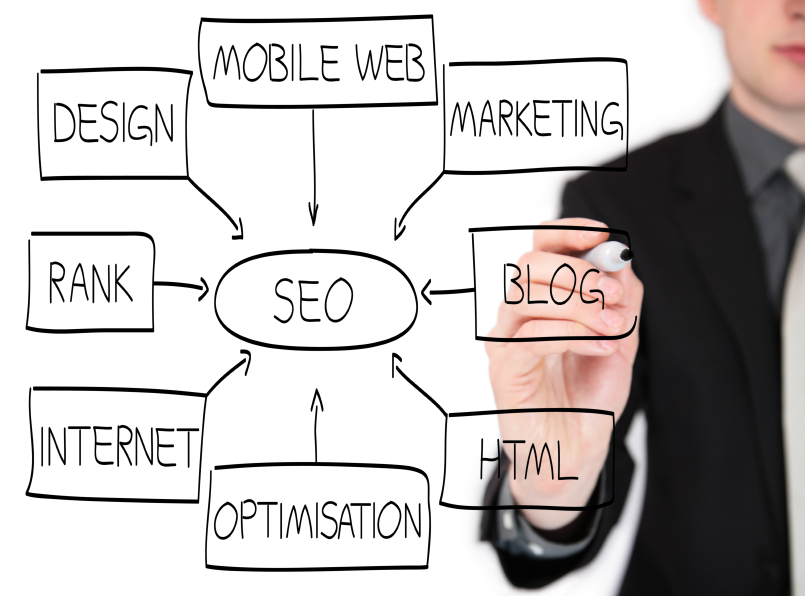
- Well written content at as simple a level as possible.
- Keywords and search phrases researched using common tools.
- HTML structured with titles, headers, and meta information.
- A clear and logical structure through menu navigation.
- Thoughtful use of graphics and photos.
- Optimized for web server performance.
- Optimized for crawling and indexing by search engine bots.
Think of your website as being like a book that has a title, table of contents, chapters, and index. Well organized is how Google likes it. This is what is considered "on-the-page seo".
Off-the-Page SEO
You may also want to do some "off-the-page seo" which would include:
- Inbound links - links from other sites to your site.
- Social networks - developing a presence on select social networks and linking to your site.
- Guest blogging on other related sites.
To do it all may seem like a lot of work and sometimes it is. It depened on the nature of your site and the business needs it is addressing. The good news is that you can often do it in stages and then wait and see what the effect is before moving on.
Contact us to discuss your website SEO project.
Analytics is About Psychology, SEO is About Technology
Digital Analytics
Hopefully you've followed the guidelines for SEO in building your site and you're getting visitors. Here is where you fine tune to meet your goals.
Digital Analytics is the analysis of qualitative and quantitative data from your business and the competition to drive a continual improvement of the online experience that your customers and potential customers have which translates to your desired outcomes (both online and offline). -Avinash Kaushik
SEO and Analytics go hand in hand. You build your site following SEO best practices, you measure the visitor traffic, and then you refine your SEO to improve your success toward achieving desired outcomes. Desired outcomes differ among organizations and their missions.
Desired outcomes are also called "conversions" in analytics terminology.
Generally a website will fall into one of five categories:
- Ecommerce - the desired outcome or conversion is a sale.
- Lead Generation - a conversion would be when a visitor submits a request for more information.
- Content Publisher - the desired outcome would be for frequent visitation by the same visitor and engagement as measured by the number of pages on the site they visit.
- Online Information and Support - sites whose purpose is to provide information to visitors would also be monitored for frequent visitation and engagement.
- Branding - sites whose purpose is to build awareness, engage visitors, and develop customer loyalty.
Whatever type of website you have, we setup a mearsurement plan based on your business objectives. Raw data needs to be packaged into meaningful reports. Analysis of these reports is conducted to see where website improvements might be made. Candidates for improvemeent are tested on the site. Lastly, the improvements are finalized and implemented on the site. It doesn't necessarily end there and this process can be repeated until you feel you are getting the most out of your site.
Analytics is all about tracking visitor behavior once they land on your site. How many leave right away which is known as bouncing? Do they dig deeper? What page do you want them to click through to? When they get there do they convert? These are the questions analytics tries to answer and the tools available can be quite complex. Google offers many tools and reporting features that you can combine to create meaningful and insightful reports. Three things Google will advise you is needed to get the most out of analytics is to setup conversions, filters, and groupings.

Search Engine Optimization
Step 2- build your site and create content with SEO in mind. SEO includes key search word and phrase research, well organized content structure, back link building, and social media integration.
Cloud Based Solutions

So many services are now being hosted "in the cloud". Email is seeing a lot of migration to a cloud based service. Companies that specialize in email hosting can do a much better job at that one thing than most companies can by keeping a mail server in house.
Contact us to discuss your cloud computing needs.
Website Data Analysis

Analysis of your website visitor data to improve your goal conversion is a continual process.
Contact us to discuss your website analytics needs.