
Super User
Website Maintenance
Website Maintenance, Updates, Backups, and More

The Web Server cPanel
This set of tasks completes the process of having a web presence. Here's a listing of just the highlights of cPanel features of our hosting service:
- Email configuration- setup accounts, webmail setup, spam filtering configuration, email forwarding, and Google Apps setup.
- File Management- ftp file manager, disk space usage monitoring.
- Restore Vault- access twice daily backups and restore.
- Awstats- monitor reports on visitors, where they come from, what pages they viewed, how long they stayed, and what pages they entered from.
- Security- password protect directories and more.
- Databases- create and manage MySQL and Postres databases.
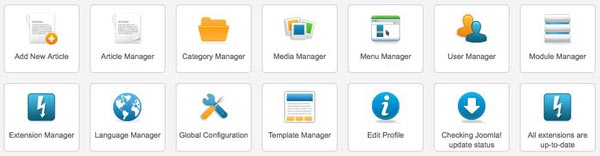
The CMS Administrative Panel
The administrative panel of each of the CMS's is different. PIctured above is the Joomla! control panal. Here's the main features that they all share:
- Backup- each has their own system for backup and restore. This is usually a third party plug-in and is not shown in the icon panel above.
- User Manager- create new users and assign them privileges to access areas of the admin section and to perform specific operations.
- Article Manager- if the user has the privileges they can create, approve, and/or publish new content.
- CMS Updaing- one click updating of the platform software.
- Extension Updaing- easily update any third party extensions added to your website.
Xojo Features
xojo Features
A Professional Development Tool
Xojo is a truly cross-platform development tool and that is why we use it. Our clients are always mixed platform environments with needs on the Macintosh and Windows platform. If you programmed with the BASIC programming language years ago then forget any of your assumptions. This is a modern programming tool and is an object oriented programming environment. It is robust and allows us to write on any platform we want and then compile to all three platforms.
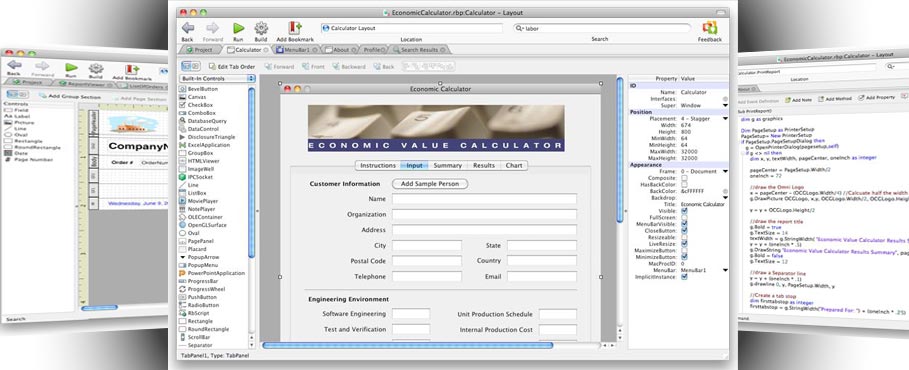
- Desktop Applications
Write applications to run on Windows, Macintosh, or Linux desktop computers
- Web Applications
Use Xojo Web Edition to develop web applications
- Client Server Database
Choose from a number of database systems and use Xojo to develop the user interface
- Mobile Device Apps
We are eagerly awaiting the soon to be released iOS version of Xojo that will allow for the development of iPhone apps.
Interested? Have a need for an application?
Contact UsSEO

Search Engine Optimization
Step 2- build your site and create content with SEO in mind. SEO includes key search word and phrase research, well organized content structure, back link building, and social media integration.
Site Management - OLD TAB

Backups, Updates, & Maintenance
Step 4- maintain your website. Common to all our websites is the cPanel application used to manage the backend of your site. Setting up email accounts with spam filtering, checking visitor activity, viewing log files, or restoring backups are just some of the features.
Content Management Systems
30% of all websites in the world are based on a Content Management System (CMS). A CMS will provide a sound foundation upon which to build websites for fun, business, community groups, or large geographically distributed organizations. There is a system for everybody and some are better fits for you than others. After getting a sense for your needs we will use one of three.

WordPress is the most popular content management system on the web today accounting for about 54% of all CMS based websites. It's the easiest to install and configure. There's many very good themes to select from as your site design. Developers have supported it with a large number of widgets and plug-ins. It's also very easy to customize and update with new content. It's the simplest of the CMS systems and it's simplicity may very well be the limiting factor. No software can simultaneously be simple and have a complex set of features though their marketing would have you believe it. It is designed to be a blog though often times we use it for a site where we don't use the blog feature. It's a good choice for a professional person such as lawyer, photographer, labor trades, and of course writers. We find WordPress an ideal choice for fun websites that won't have many users.

Joomla! is the second most popular content management systems used today. Approximately 9.2% of the world's websites that use a CMS use Joomla! With Joomla! you can build web sites and powerful online applications. It's ease of use and extensibility have made Joomla! the best choice for most small businesses. Examples are corporate websites or portals, intranets, extranets, online magazines, newspapers, publications, e-commerce, online reservations, non-profit and organizational web sites, community based portals, school and church web sites.
Joomla! is an "industrial strength" system that is easy for users to understand and work with. It is the perfect choice for integrating an e-commerce solution such as Virtue Mart or Magento. If you don't need an e-commerce solution that complicated then there are many others to choose from. Contact us to discuss Joomla! in more detail.

Drupal is the third most popular CMS in use today. It accounts for approximately 6.7% of all websites that use a CMS. Drupal is an "interesting" product. It has a following of very dedicated devotees. It may very well be the more sophisticated of the the three top CMS systems and, perhaps, that is what keeps it from being more widely adapted. Those who spend some of each day working with a CMS find it easy enough to work with but those who just want a website and simply want to make the occasional update find Drupal more difficult to learn and work with. The bottom line for us is if you have a staff and can have someone devote some time to learning Drupal then this is a good solution. If not then choose one of the other two.
Application Development
Application Development
Xojo is a cross-platform development environment that works on Windows, Macintosh, and Linux. Write once and complie for all three platforms.
Desktop applications, client-server database, web applications, and applications for mobile devices can all be developed using Xojo.
Xojo is a robust object-oriented programming language that allows us to write on any platform we want and then compile to all three platforms.
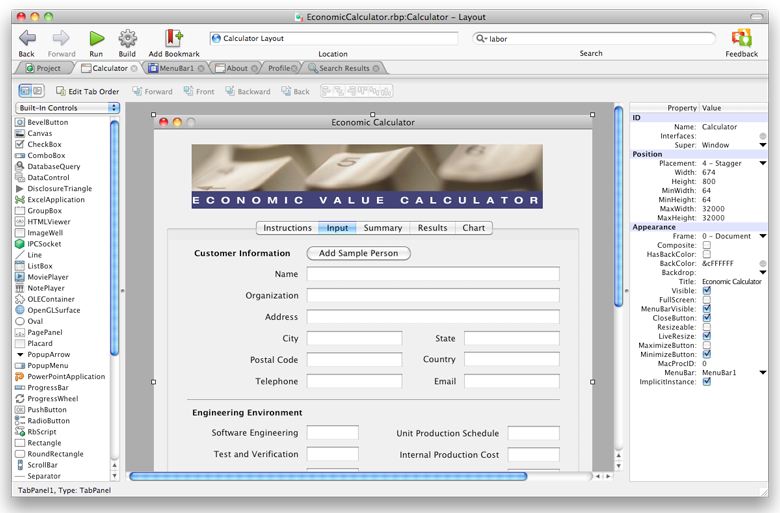
Xojo Details

Development Costs
- Licensing: we write the software so there is no software licensing involved.
- Database Licensing: if your application requires a database there may be a cost associated with the licensing of the database depending on your choice of database.
- Rapid Application Development: drag and drop interface building, object oriented programming, lots of plug-ins and classes available for free or purchase.

Software Licensing
Normally when buying software you have to purchase the licensing in the form of a downloaded file, DVD, or shrink wrapped box. Here you have nothing to buy. We have purchased the development software that allows us write the software that you deploy throughout your organization. There is no per seat cost or annual update cost. Often, as is the case with popular database programs, we can write and deploy software for about what it costs just to license the software for 10 users.
Database Licensing
If there is a database involved with your application there may be a cost associated with that. Most people opt for one of the free open source database systems. Four that make good choices are SQLite, MySQL, MariaDB, or PostgreSQL. Oracle and Microsoft SQL Server are high end options. There are a couple of other options as well as an ODBC plug-in.
Rapid Application Development

Xojo is a Rapid Application Development (RAD) tool. It's GUI builder allows for the quick building of the user interface. Behind that lies a modern object oriented version of the BASIC programming language that is nothinglike the BASIC of years ago. Objective-C, C++, or Java are complex by comparison and when you realize that Xojo allows you to develop one application and compile it for Windows, Macintosh, and Linux you begin to understand how cost effective this is.